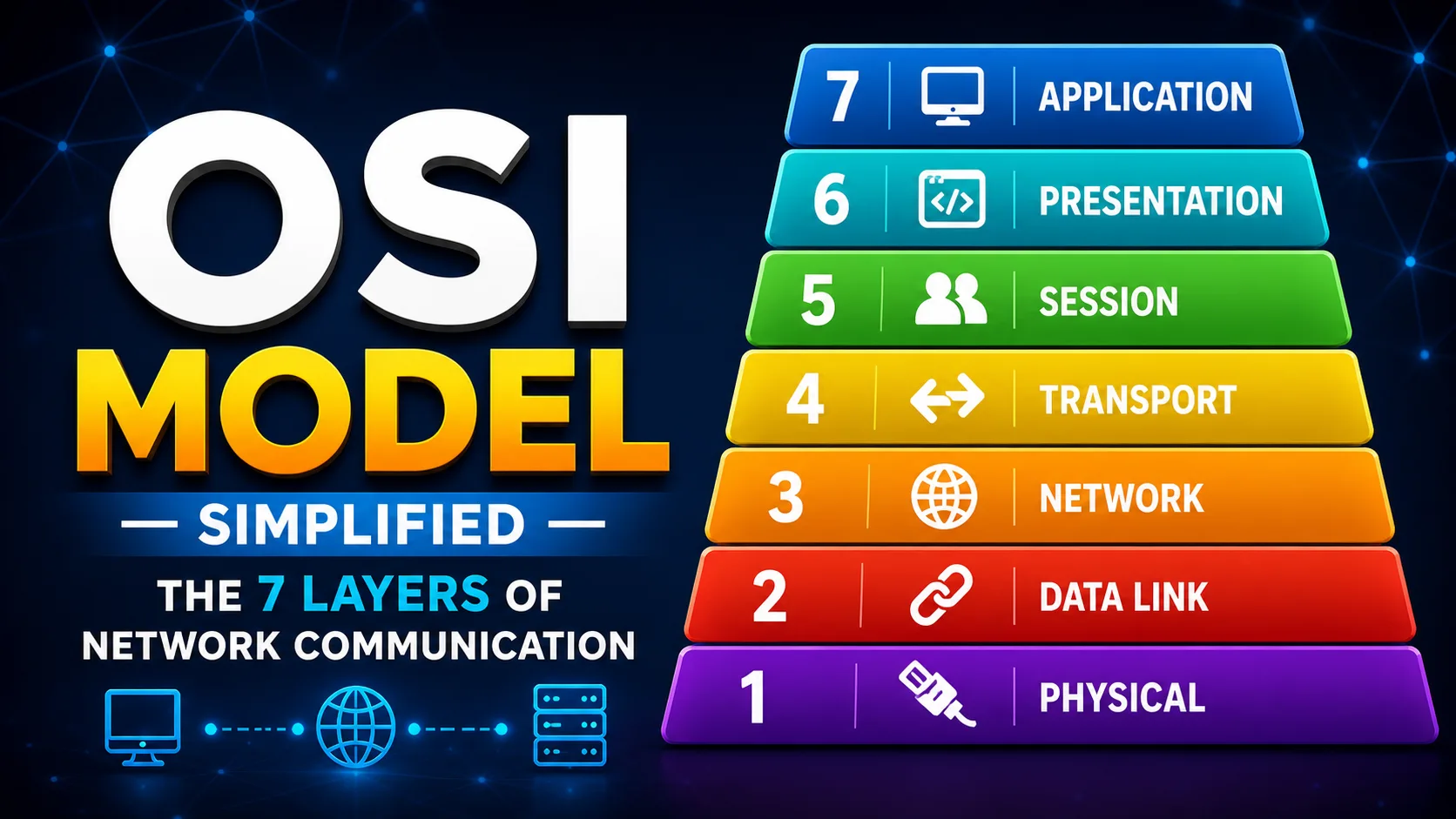

The OSI Model is a conceptual framework used to understand how data travels across a network. It divides network communication into seven logical layers, each responsible for a specific part of the communication process.
The model was developed by the International Organization for Standardization to standardize how different computer systems communicate with each other.
Understanding the OSI model is essential for network engineers, system administrators, and cybersecurity professionals, because it helps diagnose network problems and understand how protocols interact.
The 7 Layers of the OSI Model
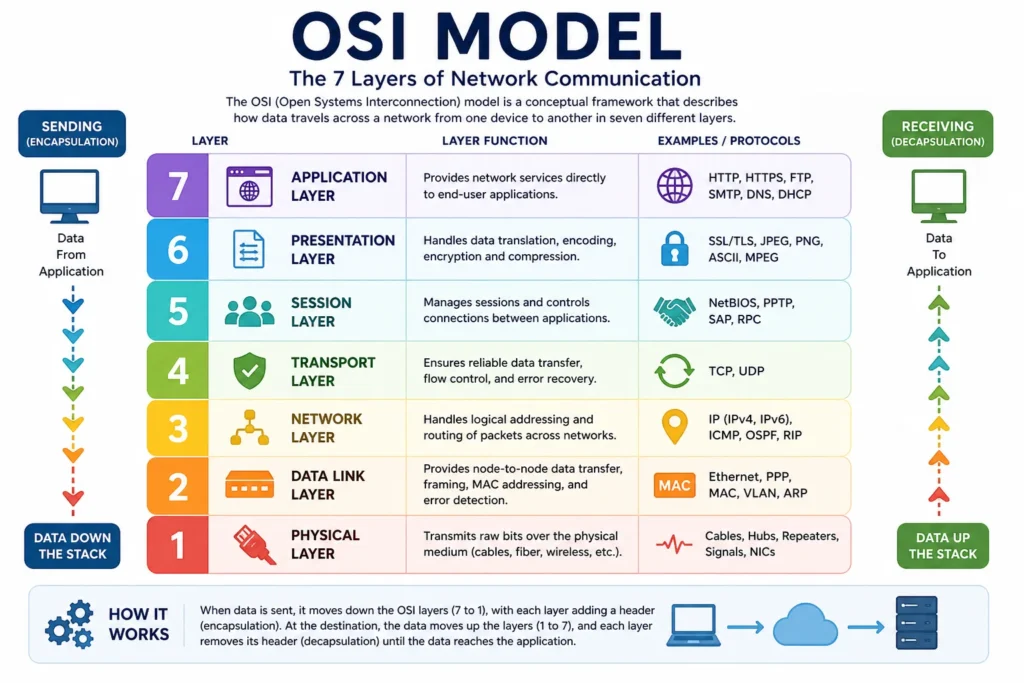
The OSI model consists of seven layers, starting from the physical hardware level up to the application level used by users.
OSI Model Flow Diagram
+-----------------------+
| 7. Application Layer  |
| User-level services   |
| (HTTP, FTP, SMTP)    |
+-----------------------+
| 6. Presentation Layer |
| Data translation      |
| Encryption, encoding  |
+-----------------------+
| 5. Session Layer      |
| Session management    |
| Connection control    |
+-----------------------+
| 4. Transport Layer    |
| Reliable delivery     |
| TCP / UDP protocols   |
+-----------------------+
| 3. Network Layer      |
| Logical addressing    |
| Routing (IP)          |
+-----------------------+
| 2. Data Link Layer    |
| MAC addressing        |
| Frame transmission    |
+-----------------------+
| 1. Physical Layer     |
| Cables, signals, NICs |
| Electrical transfer   |
+-----------------------+
Data travels from Layer 7 down to Layer 1 when sending and from Layer 1 up to Layer 7 when receiving.
Detailed Explanation of Each Layer
1. Physical Layer
The Physical Layer is responsible for transmitting raw bits over a physical medium such as cables, fiber optics, or wireless signals.
Examples:
- Ethernet cables
- Network interface cards
- Electrical signals
This layer focuses on hardware-level communication.
2. Data Link Layer
The Data Link Layer ensures reliable communication between two directly connected devices.
Key responsibilities:
- MAC addressing
- Error detection
- Frame synchronization
Devices working here include:
- Network switches
- Network interface cards
3. Network Layer
The Network Layer handles logical addressing and routing so data can travel between different networks.
Key responsibilities:
- IP addressing
- Packet routing
- Path determination
Common protocol:
- IP (Internet Protocol)
Routers operate at this layer.
4. Transport Layer
The Transport Layer ensures reliable data transfer between systems.
Main tasks:
- Data segmentation
- Flow control
- Error recovery
Two important protocols:
- TCP (Transmission Control Protocol)
- UDP (User Datagram Protocol)
TCP ensures reliability while UDP provides faster communication.
5. Session Layer
The Session Layer manages communication sessions between applications.
Responsibilities include:
- Session establishment
- Session maintenance
- Session termination
This layer ensures continuous communication between devices.
6. Presentation Layer
The Presentation Layer ensures that data is formatted in a way that both systems can understand.
Functions include:
- Data encryption
- Data compression
- Data translation
For example, it converts data into formats such as ASCII or JPEG.
7. Application Layer
The Application Layer is the closest layer to the user and provides network services to applications.
Examples include:
- Web browsing
- Email communication
- File transfers
Common protocols:
- HTTP
- FTP
- SMTP
- DNS
This layer allows users to interact with network services.
Why the OSI Model Is Important
The OSI model is widely used for several reasons:
1. Troubleshooting Networks
When a network problem occurs, engineers can identify which layer is causing the issue.
Example:
- Cable issue → Physical Layer
- IP routing problem → Network Layer
- Web server issue → Application Layer
2. Standardization
It provides a universal framework that allows different technologies to work together.
3. Easier Learning
The layered architecture makes networking concepts easier to understand and organize.
Simple Mnemonic to Remember the OSI Layers
From top to bottom:
A P S T N D P
Application
Presentation
Session
Transport
Network
Data Link
Physical
A common mnemonic:
“All People Seem To Need Data Processing.”
Conclusion
The OSI Model remains one of the most important concepts in computer networking. By dividing communication into seven layers, it provides a clear way to understand how data moves from one device to another across complex networks.
Whether you are studying networking, preparing for certifications, or working in system administration, mastering the OSI model will help you understand the fundamental structure of modern network communication.