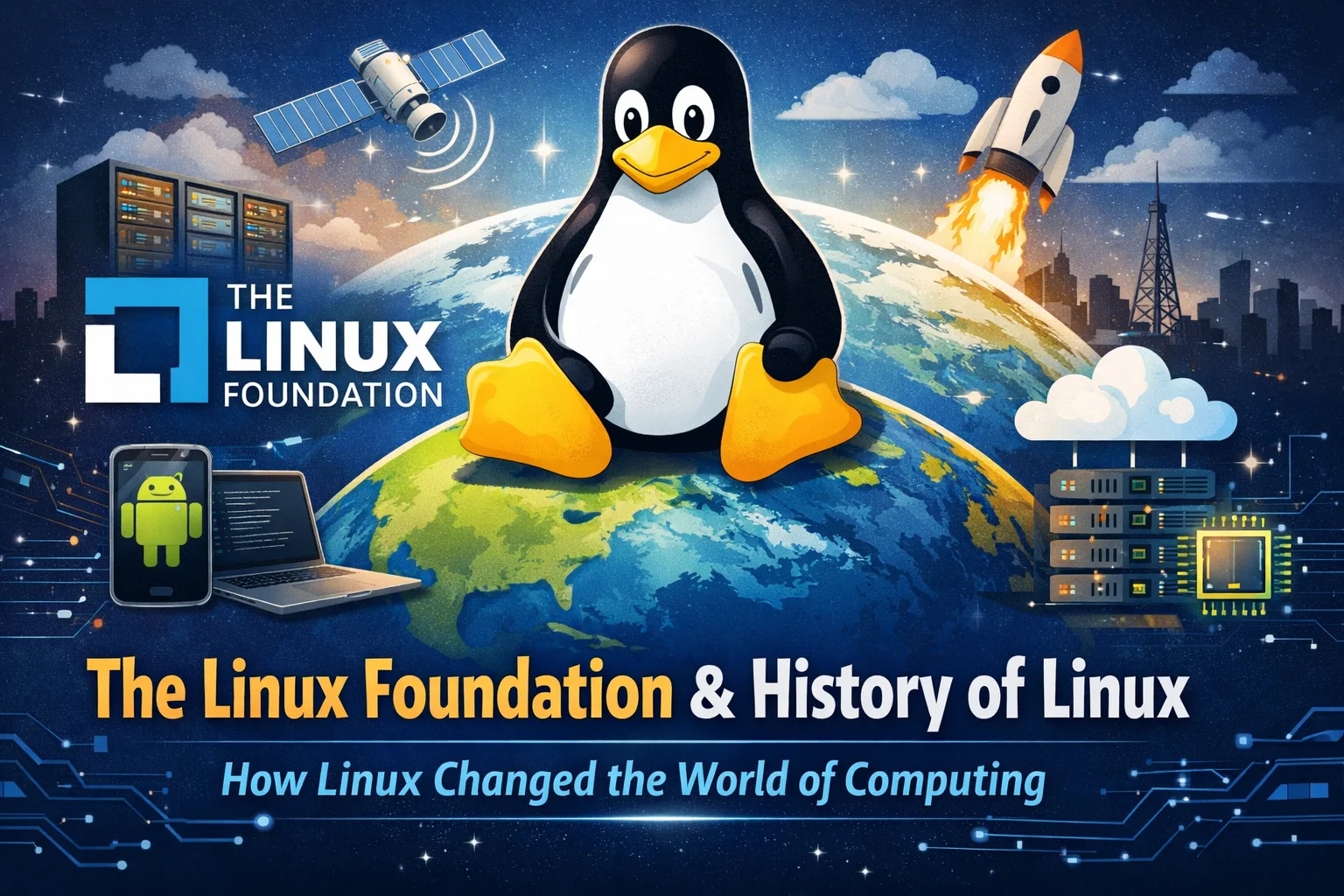

Over the last three decades, Linux has transformed from a small hobby project into one of the most powerful technologies in the modern digital world. Today Linux runs servers, cloud infrastructure, smartphones, supercomputers, and even spacecraft. Behind much of its development and collaboration is an organization known as the Linux Foundation.
Understanding how Linux began and how it evolved helps us see why it has become such a critical part of global computing.
The Birth of Linux
The story of Linux began in 1991, when a Finnish computer science student named Linus Torvalds started working on a personal operating system kernel as a hobby project.
At the time, many developers used a teaching operating system called MINIX, but it had limitations. Linus wanted to build a system that was more powerful and flexible for personal computers.
He announced his project on an online forum with a now-famous message explaining that he was building a free operating system kernel for the Intel 80386 PC.
What started as a small personal project quickly attracted programmers around the world who wanted to contribute.
What Is Linux Exactly?
Many people use the word Linux to refer to the whole operating system, but technically Linux is only the kernel.
The kernel is the core component of an operating system. It controls:
- CPU communication
- memory management
- hardware interaction
- process scheduling
When the Linux kernel is combined with tools from the GNU Project, it becomes a full operating system commonly called GNU/Linux.
The Creation of the Linux Foundation
As Linux became widely used in enterprise systems and infrastructure, companies needed a way to support its development collaboratively.
In 2007, two major organizations merged:
- Open Source Development Labs
- Free Standards Group
This merger created the Linux Foundation.
The foundation now supports the development of many important open-source technologies and coordinates collaboration among thousands of developers and companies.
Major companies that support Linux development include:
- IBM
- Intel
- Microsoft
- Red Hat
Popular Linux Distributions
Over time, many operating systems built around Linux were created. These are called Linux distributions.
Some well-known examples include:
- Ubuntu
- Fedora Linux
- Debian
- Arch Linux
- Red Hat Enterprise Linux
Each distribution is designed for different use cases such as servers, desktops, cloud infrastructure, or development environments.
Why Linux Changed the World of Computing
1. Open Source Collaboration
Linux introduced a powerful development model where anyone could contribute to improving the software.
Thousands of developers worldwide collaborate to build and improve Linux, making it one of the largest software projects in history.
2. Stability and Reliability
Linux systems are famous for their ability to run for months or even years without crashing.
This reliability makes Linux the preferred choice for:
- enterprise servers
- cloud platforms
- financial systems
- telecommunications networks
3. Security
Because Linux is open source, vulnerabilities can be found and fixed quickly by the global developer community.
Many security-sensitive systems rely on Linux because it provides strong control over system configuration and permissions.
4. Dominance in Servers and Cloud Computing
Most of the internet runs on Linux.
Major cloud platforms rely heavily on Linux infrastructure, including:
- Amazon
- Microsoft
Cloud computing, containers, and modern infrastructure technologies like Kubernetes were all built with Linux at their core.
5. Powering Smartphones
The most widely used mobile operating system, Android, is built on top of the Linux kernel.
Billions of smartphones worldwide rely on Linux technology every day.
6. Supercomputers
Linux dominates high-performance computing.
Today nearly 100% of the world’s top supercomputers run Linux-based operating systems because of its flexibility and performance.
Linux in the Future
Linux continues to grow in importance as technology evolves.
It plays a major role in:
- cloud computing
- artificial intelligence infrastructure
- edge computing
- Internet of Things (IoT)
- containerized applications
Because of its open development model and strong community support, Linux will likely remain the backbone of modern computing for decades to come.
Final Thoughts
Linux started as a small project created by a university student ‘Linus Torvalds’. Today it powers much of the digital world. Through open collaboration, transparency, and community-driven development, Linux has proven that open-source software can compete with and even surpass proprietary systems.
The work of the Linux Foundation continues to push innovation forward, ensuring that Linux remains one of the most important technologies shaping the future of computing.