
If you’re serious about building a career in web development, the biggest challenge isn’t lack of resources. It’s confusion. There are too many tools, too many opinions, and no clear path.
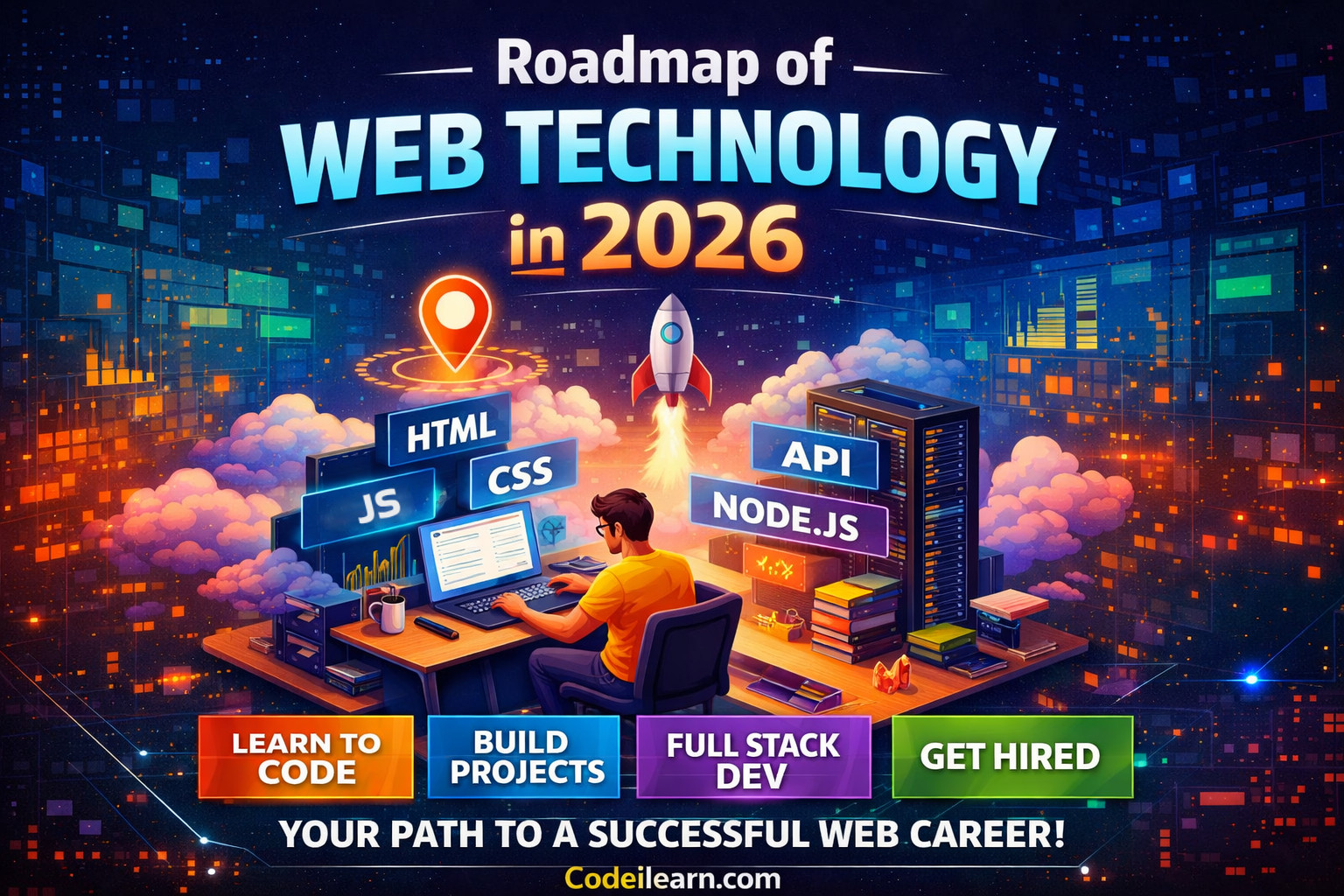
This roadmap is designed to give you a practical, no-nonsense direction for learning web technology in 2026. Whether you’re starting from scratch or trying to level up, follow this in order and you’ll build real, job-ready skills.
1. Start with the Fundamentals (Don’t Skip This)
Everything in web development is built on three core technologies:
- HTML → Structure
- CSS → Styling
- JavaScript → Logic
👉 Learn here:
- https://developer.mozilla.org/en-US/docs/Web/HTML
- https://developer.mozilla.org/en-US/docs/Web/CSS
- https://developer.mozilla.org/en-US/docs/Web/JavaScript
Focus on:
- Semantic HTML
- Flexbox & Grid
- DOM manipulation
- Events and basic logic
Goal: Build simple static websites without copying code blindly.
2. Version Control (Start Early)
Before going deeper, learn Git and GitHub.
👉 Learn here:
Focus on:
- commit, push, pull
- branching
- working with repositories
Why it matters: Every company uses Git. It’s non-negotiable.
3. Modern JavaScript (Core Skill in 2026)
JavaScript is still the backbone of web development.
Focus on:
- ES6+ (arrow functions, destructuring, modules)
- Async JavaScript (Promises, async/await)
- Fetch API
👉 Learn here:
Goal: Be comfortable writing clean, modular JS code.
4. Frontend Frameworks (React is Still King)
In 2026, frameworks are essential.
Start with:
- React
👉 Learn here:
Focus on:
- Components
- Props & State
- Hooks (useState, useEffect)
- API integration
Optional later:
- Next.js (for production apps)
Goal: Build dynamic, real-world UI.
5. Styling Like a Pro
Basic CSS is not enough anymore.
Learn:
- Tailwind CSS
- Responsive design
- UI consistency
👉 https://tailwindcss.com/docs
Goal: Build clean, modern UI quickly.
6. Backend Development (Become Full Stack)
To become job-ready, you need backend knowledge.
Start with:
- Node.js
- Express.js
👉 Learn here:
Focus on:
- APIs (REST)
- Authentication basics
- CRUD operations
7. Databases (Store Real Data)
Learn at least one database:
- MongoDB (easy for beginners)
- PostgreSQL (better for scaling)
👉 Learn here:
Goal: Connect frontend to real data.
8. APIs & Real-World Integration
Learn how apps communicate.
Focus on:
- REST APIs
- JSON handling
- Third-party APIs
👉 https://developer.mozilla.org/en-US/docs/Web/API/Fetch_API
9. Deployment (Make Your Work Live)
If your project is not online, it doesn’t exist.
Use:
- Vercel
- Netlify
👉 https://vercel.com/docs
👉 https://docs.netlify.com
Also learn:
- basic hosting
- environment variables
10. Advanced Skills (Stand Out in 2026)
Once you’re comfortable, move to:
- TypeScript → https://www.typescriptlang.org/docs/
- System Design basics
- Performance optimization
- Security fundamentals
Optional but powerful:
- WebSockets (real-time apps)
- Docker (for deployment)
11. Build Projects (This Is Everything)
You don’t get hired for watching tutorials.
Build:
- Portfolio website
- Blog system
- Chat app
- Dashboard
👉 Inspiration: https://github.com/topics/web-development
Rule: One strong project > 10 incomplete ones
12. Stay Updated (Tech Changes Fast)
Follow:
Final Advice
Don’t try to learn everything at once.
Focus on:
- consistency over intensity
- building over watching
- understanding over copying
Web development in 2026 is not about knowing every tool.
It’s about knowing how to learn and build efficiently.
Your Next Step
Start today with:
- HTML + CSS
- Build a simple page
- Add JavaScript
- Push to GitHub
Repeat.
That’s how real developers are made.
CodeIlearn.com is here to help you stay on track. Keep learning, keep building, and turn your skills into real opportunities.